Search
Table of Contents
- What Is Application Security Posture Management (ASPM)?
-
State of ASPM 2026: Key Trends & Emerging Threats
- ASPM Market Evolution and Adoption Trajectory
- AI-Native ASPM and Machine Learning Integration
- Cloud-Native Security Challenges and Container Orchestration Threats
- Software Supply Chain Vulnerabilities and SBOM Evolution
- DevSecOps Integration and Future ASPM Architecture
- ASPM Key Trends & Threats FAQs
- How DSPM Is Evolving: Key Trends to Watch
-
What Is a Software Bill of Materials (SBOM)?
- Software Bill of Materials Explained
- Who Should Have a SBOM
- The Role of SBOMs in Cybersecurity and Compliance
- Why Is an SBOM Important?
- Software Composition Analysis and SBOMs
- How Does an SBOM Help Prevent Open-Source Supply Chain Attacks
- SBOM Formats
- Software Bill of Materials Best Practices
- SBOM FAQs
- CSPM Vs ASPM: Where Your Focus Belongs
- What Is Policy-as-Code?
- Buy or Build: Calculating ASPM ROI for Your Organization
- What Is Static Application Security Testing (SAST)?
- CNAPP and ASPM Collaboration, Not Collision
- What Is Infrastructure as Code (IaC) Supply Chain Security?
-
Application Security Best Practices You Can’t Skip in ASPM
- ASPM Architecture: From Tool Sprawl to Unified Intelligence
- Advanced Risk Correlation and Contextual Prioritization Systems
- Policy-Driven Security Automation and Enforcement Architecture
- Seamless DevOps Integration and Cloud-Native Security Orchestration
- Enterprise Scalability, Performance Engineering, and Compliance Automation
- Application Security In ASPM Best Practices FAQs
- ASPM: The Evolution Beyond ASOC
- Overcoming AppSec Chaos: 7 Modes of ASPM Adoption
-
How ASPM Strengthens Your Cloud Ecosystem
- ASPM's Role in Unified Cloud Security Architecture
- Integration Points Across the Cloud Security Stack
- Risk Intelligence and Contextual Prioritization in Cloud Environments
- Operational Efficiency Through Automated Cloud Security Workflows
- Strategic Advantages for Cloud-First Organizations
- ASPM Strengthening the Entire Cloud Ecosystem FAQs
- Interactive Application Testing & ASPM: Closing DevSec Gaps
- Top Cloud Data Security Solutions
- Selecting Your ASPM Solution: Metrics That Matter
- ASPM in Action: 8 Real‑World Use Cases
-
How Supply Chain Threats Are Shaping ASPM Today
- The Supply Chain Attack Surface in Modern ASPM
- Critical Supply Chain Vectors Driving ASPM Evolution
- Software Supply Chain Risk Assessment and Prioritization
- Architectural Shifts in ASPM for Supply Chain Defense
- Operationalizing Supply Chain Security Within ASPM Programs
- Supply Chain Threats Are Shaping ASPM FAQs
-
Developer Infrastructure Posture: Integrating ASPM Early
- Understanding Developer Infrastructure Posture
- ASPM Fundamentals: Beyond Traditional Application Security
- Early Integration Strategies: Embedding ASPM in Developer Workflows
- ASPM Compliance Framework Integration
- Risk Prioritization and Remediation at Scale
- Developer Infrastructure Posture Management and ASPM FAQs
- Amplify ASPM with RBVM Risk‑Based Vulnerability Management
-
Why You Need Static Analysis, Dynamic Analysis, and Machine Learning?
- What Is Code Security?
- What is Infrastructure-as-Code Security
- What is IaC?
- What Is Secrets Management?
- ASPM Tools: Evaluation Criteria and How to Select the Best Option
What Is Software Composition Analysis (SCA)?
3 min. read
Table of Contents
Software composition analysis (SCA) provides a deep analysis of open source packages in use by an application. SCA highlights vulnerabilities and licenses in dependencies for risk and compliance assessments, and it can generate a software bill of materials (SBOM) of all resources to share with internal stakeholders and external customers.
What Is Software Composition Analysis?
Software composition analysis safely enables developers to leverage open source packages without exposing organizations to unnecessary vulnerabilities or legal and compliance issues.
Open source components have become pervasive in modern software development, with the majority of modern applications’ codebases made up of such packages. This method allows developers to move more quickly since they don't need to recreate code that is freely available and vetted by the community. However, this process also comes with its own set of risks.
What Are the Risks of Using Open Source Components?
Before building container images with these components, developers need to be aware of security concerns stemming from previously discovered vulnerabilities in the packages. They also need to ensure they are meeting compliance requirements around software use licenses.
Community members frequently find and patch vulnerabilities, but the burden is on developers to update their code. When a vulnerability is found, it’s only a matter of time before a public exploit is made available, opening the door for even low-level attackers to take advantage of the issue.
The problem is exacerbated by the fact that a majority of vulnerabilities in software are not in immediate or root packages but in dependencies of dependencies, multiple layers deep. Fixing just the root packages in use will not always secure the libraries in use.
Additionally, there are dozens of open source licenses with a variety of rules. For example, some require attribution while others require the source code for the application that uses the component to also be published. Keeping track of all of the licenses and their rules can be difficult.
Software Composition Analysis Identifies Risks in Open Source Packages
SCA tools identify all open source packages in an application and all the known vulnerabilities of those packages. This knowledge can be used to notify developers of the issues in their code to fix them before they are exploited. A good software composition analysis process will look beyond package managers into infrastructure as code (IaC) and Kubernetes manifests, pulling images to identify vulnerabilities in those images. 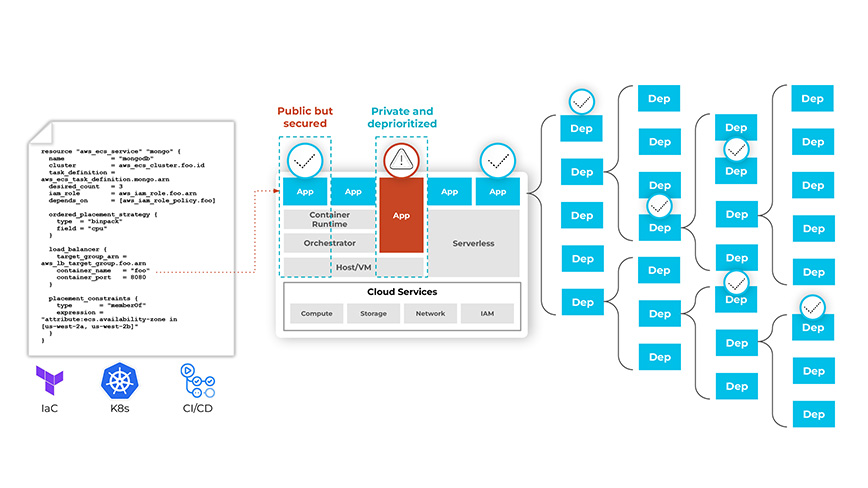
SCA tools with connections to IaC templates and limitless dependency scanning ensure vulnerabilities don’t go undetected or unresolved.
Software composition analysis tools can also be used to generate a software bill of materials (SBOM or software BOM) that includes all the open source components used by an application. The SBOM lists details about the package version as well as known vulnerabilities and licenses for each component in use. For example, for Python, the BOM will include all the packages in import statements, such as httplib2, along with the version number, discovered vulnerabilities and licenses for each package.
SCA programs should enable collaboration among stakeholders such as engineering, DevOps, security and compliance teams. Many organizations will use these programs to create alerts and/or block code from merging into repositories if said code includes open source components that violate the organization’s compliance mandates for controlling exposure. Determining an acceptable severity level for vulnerabilities and license types should involve the relevant stakeholders.
How to Use SCA in the Development Processes
A good SCA process is embedded throughout the development process. Starting in local environments, developers need to be able to check their code for vulnerabilities and license compliance as they write it.
Leveraging integrated development environments (IDEs) plugins, SCA tools can notify developers about vulnerabilities as they add packages. Before code is committed to a repository, checks and automated pull request comments should inform developers of any issues being introduced and block code that does not meet requirements.
This should carry over to deployments where software with predetermined levels of vulnerabilities or types of licenses can be blocked from being deployed. Security teams should also have broad visibility into the posture of the components in their environment.
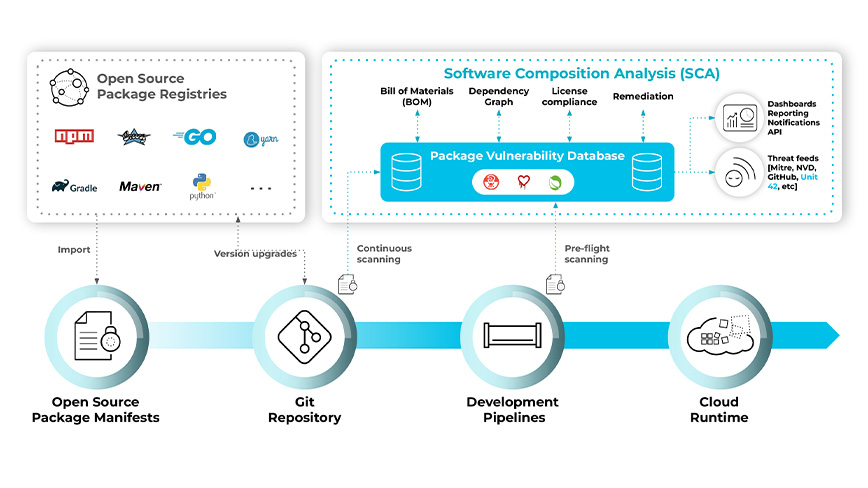
Software composition analysis extends coverage from code to cloud and from infrastructure to application layers to track vulnerabilities throughout the development lifecycle.
In all areas, developers should be informed about risks to which the packages can expose them. Vulnerabilities need to be ranked and prioritized (e.g., using CVE scores and time since the vulnerability was reported) based on criticality and infrastructure impacts (e.g., if the vulnerable package is in a private VPC). Licenses should be grouped by those allowable but that require additional details, such as attribution, and those that are not allowable under organization policies, such as "copyleft" licenses.
The Benefits of Software Composition Analysis
It is important for teams to be aware of the posture of their application environments. By providing license compliance and vulnerability feedback early and often, software composition analysis helps alleviate some of the risks of using open source components in applications. While 100% patch rates are unlikely, knowing the risk and weighing the cost to fix a vulnerability is part of improving security posture.
To learn more about securing modern development processes, check out What Is DevSecOps?
Software Composition Analysis FAQs
Open-source component identification in SCA involves scanning a software codebase to detect all open-source libraries and frameworks used. This process generates an inventory of components, including their versions and origins. Accurate identification is crucial for assessing security vulnerabilities, license compliance, and potential legal issues. Tools like Snyk and WhiteSource use advanced algorithms and extensive databases to identify components accurately. By understanding the open-source components in use, organizations can manage risks effectively and ensure that their software development practices align with industry standards.
Vulnerability detection in SCA involves scanning open-source components for known security vulnerabilities. SCA tools compare identified components against vulnerability databases such as the National Vulnerability Database (NVD) and proprietary sources. This process highlights security flaws, enabling developers to address them proactively. Vulnerability detection helps prevent exploitation of weaknesses in open-source libraries, reducing the risk of data breaches and cyberattacks. Tools like Black Duck and Snyk provide real-time vulnerability alerts and detailed remediation guidance, enhancing the security posture of software projects.
License compliance in SCA ensures that open-source components used in software projects adhere to legal and regulatory requirements. SCA tools analyze the licenses associated with each component, identifying potential conflicts and obligations. This process helps organizations avoid legal risks and ensure that they comply with open-source license terms. License compliance also involves tracking and managing license obligations, such as attribution and distribution requirements. Tools like WhiteSource and FOSSA provide comprehensive license compliance solutions, enabling organizations to manage open-source usage responsibly and mitigate legal risks.
Dependency management in SCA involves tracking and controlling the third-party libraries and frameworks that a software project relies on. SCA tools identify direct and transitive dependencies, providing insights into their security and compliance status. Effective dependency management ensures that components are up-to-date and free from known vulnerabilities. It also involves automating updates and resolving dependency conflicts. Tools like Snyk and Renovate offer advanced dependency management features, integrating seamlessly into development workflows to enhance software security and maintainability.
Risk assessment in SCA evaluates the security, legal, and operational risks associated with open-source components. SCA tools analyze component vulnerabilities, license terms, and maintenance status to provide a comprehensive risk profile. This process helps organizations prioritize remediation efforts based on the severity and impact of identified risks. Effective risk assessment enables informed decision-making and proactive risk management. Tools like Black Duck and WhiteSource offer detailed risk assessment reports, empowering development teams to address critical issues and enhance the overall security of their software projects.
Remediation in SCA involves addressing identified vulnerabilities and compliance issues in open-source components. SCA tools provide detailed guidance on fixing security flaws, such as upgrading to secure versions or applying patches. Remediation also includes resolving license conflicts and meeting legal obligations. Automated remediation workflows streamline the process, enabling rapid and effective responses to identified risks. Tools like Snyk and WhiteSource offer integrated remediation solutions, helping development teams maintain secure and compliant software while minimizing operational disruption.
Continuous monitoring in SCA involves ongoing scanning and analysis of open-source components to detect new vulnerabilities and compliance issues. SCA tools provide real-time alerts and updates, ensuring that development teams are aware of emerging risks. Continuous monitoring enhances security by enabling proactive risk management and timely remediation. It also supports compliance by tracking changes in license terms and regulatory requirements. Tools like Black Duck and Snyk offer continuous monitoring features, integrating seamlessly into CI/CD pipelines to provide ongoing protection for software projects.
Integration with CI/CD in SCA involves embedding SCA tools into continuous integration and continuous delivery pipelines. This integration automates the scanning and analysis of open-source components during the development process, ensuring that vulnerabilities and compliance issues are detected early. CI/CD integration enhances software security by incorporating SCA into the development workflow, enabling rapid identification and remediation of risks. Tools like Snyk and WhiteSource provide robust CI/CD integration capabilities, supporting secure and efficient software delivery while maintaining compliance with industry standards.
A software bill of materials (SBOM) in SCA is a comprehensive inventory of all open-source components used in a software project, including their versions and dependencies. SBOMs provide detailed insights into the composition of software, enabling effective risk management and compliance. SCA tools generate SBOMs automatically, facilitating transparency and accountability in software development. SBOMs support vulnerability detection, license compliance, and security audits. Tools like Black Duck and WhiteSource offer SBOM generation and management features, empowering organizations to maintain secure and compliant software ecosystems.


